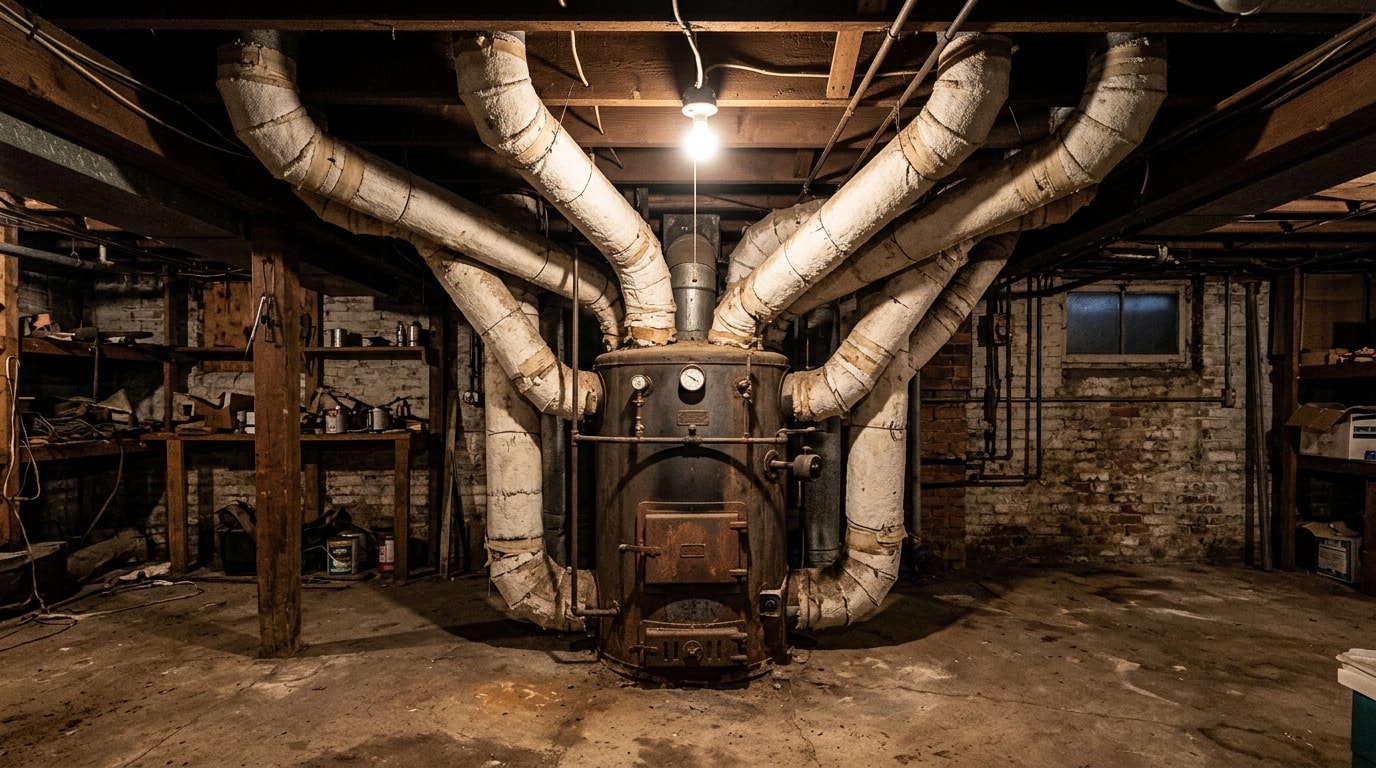
A gravity furnace in Sandy Springs, GA usually gets discovered the same way: a home inspection or a chilly upstairs room sends someone down to the basement, where a massive, octopus-shaped heating unit has been quietly running since the Eisenhower administration. These vintage systems were common across Atlanta before forced-air ductwork and central air conditioning became standard. Many still work today, but that doesn't mean they're safe, efficient, or worth keeping.
What Is a Gravity Furnace?
A gravity furnace is an early-generation heating system that moves warm air through a house using natural convection instead of a blower fan. Installed mostly before the 1950s, it burns gas, oil, or coal in a central firebox and relies on large, octopus-like ducts branching upward to each room.
Warm air naturally rises and cool air sinks, so no mechanical parts are needed to circulate heat. That's why these systems are nicknamed "octopus furnaces," after their sprawling arms of sheet-metal ductwork.
In our experience servicing older housing stock around the metro, true gravity furnaces still turn up most often in the in-town pockets of Sandy Springs, GA with homes dating to the 1930s and 1940s, rather than in the city's larger postwar subdivisions. If your home was built before 1955 and still has its original heating system, there's a reasonable chance it's a gravity furnace. Many original units were later retrofitted with blowers, so not every old gas furnace is a true gravity system. Our HVAC contractor team can confirm what you're looking at during an on-site visit.
How a Gravity Furnace Works: The Heating Cycle
A gravity furnace runs on one simple principle: warm air rises, and cool air sinks. There's no blower motor pushing air through the house. Gravity and temperature difference alone drive the convection.
The cycle starts when fuel burns in the firebox, heating the air inside the furnace's chamber. That heated air becomes lighter than the surrounding cool air, so it rises on its own through large warm-air ducts branching out from the top of the unit. Each duct feeds a floor register in a room above, where warm air spills out and gradually cools.
As that air cools, it becomes denser and sinks back down. It's pulled through cold-air return grilles and ducts that lead back to the furnace to be reheated. The cycle repeats as long as the firebox stays lit.
Because nothing mechanical forces the air, rooms farther from the furnace, or on upper floors, often heat more slowly and unevenly than rooms close to the unit.
Main Components and Their Roles
Most gravity furnace components are easy to spot once you know what to look for.
- Firebox (combustion chamber): sits at the base of the unit, where fuel actually burns.
- Heat exchanger: a metal chamber that transfers heat from combustion gases into breathable air without letting smoke or fumes mix in.
- Warm-air ducts: fan outward and upward, often a dozen or more, carrying heated air to registers throughout the home.
- Cold-air returns: bring cooled air back down to the furnace for reheating.
- Chimney: vents combustion byproducts, including carbon monoxide, safely outside.
Over decades, these parts can develop rust, cracks, or damaged insulation. That's why a visual inspection from a qualified technician matters, even if the furnace still lights and heats normally.
Quick Comparison: Gravity Furnace vs Forced Air
The table below lines up the features homeowners care about most when deciding whether to keep an old gas furnace or upgrade.
| Feature | Gravity Furnace | Forced Air Furnace |
|---|---|---|
| How it works | Natural convection, no blower | Blower fan pushes air through ducts |
| Efficiency (AFUE) | ~50-65% | 80-98% |
| Fuel types | Gas, oil, coal | Gas, electric, propane, oil |
| Moving parts | Minimal | Blower motor, fan, electronics |
| Noise | Silent operation | Audible fan/blower noise |
| AC compatibility | Not compatible without major retrofit | Compatible, shares ductwork |
| Filtration | Little to none | Standard air filters |
| Asbestos risk | High in pre-1980s units | None in modern units |
| Typical lifespan | 50-100+ years (mechanical) | 15-25 years |
| Energy cost | Higher due to heat loss | Lower, especially high-efficiency models |
The trade-off: a gravity furnace's simplicity and longevity come at the cost of comfort, air conditioning compatibility, and monthly energy spend.
Efficiency: Gravity Furnace vs. Modern Forced-Air Systems
Efficiency is where the age of a gravity furnace really shows. Most gravity furnaces operate at roughly 50-65% AFUE (annual fuel utilization efficiency), meaning nearly half the fuel burned escapes as wasted heat up the chimney. Modern forced-air furnaces must meet far higher standards, and ENERGY STAR-certified gas models have to clear a minimum AFUE threshold that is reviewed and tightened over time, with current top-tier residential models reaching into the mid-to-high 90s, according to ENERGY STAR's federal tax credit criteria for gas furnaces.
For a typical Sandy Springs home, that efficiency gap adds up over a winter. As a rough illustration, a home running a 55% AFUE gravity furnace through a normal Georgia heating season could easily spend several hundred dollars more per year than the same home with a 95%+ AFUE furnace, simply because less fuel is wasted up the flue. Exact savings depend on insulation, thermostat habits, and current gas pricing, but the pattern holds: older convection systems cost more to run every winter they stay in service.
Safety Concerns: Asbestos and Carbon Monoxide
Two safety issues come up more than any other when evaluating a gravity furnace: asbestos and carbon monoxide.
Asbestos Hazard
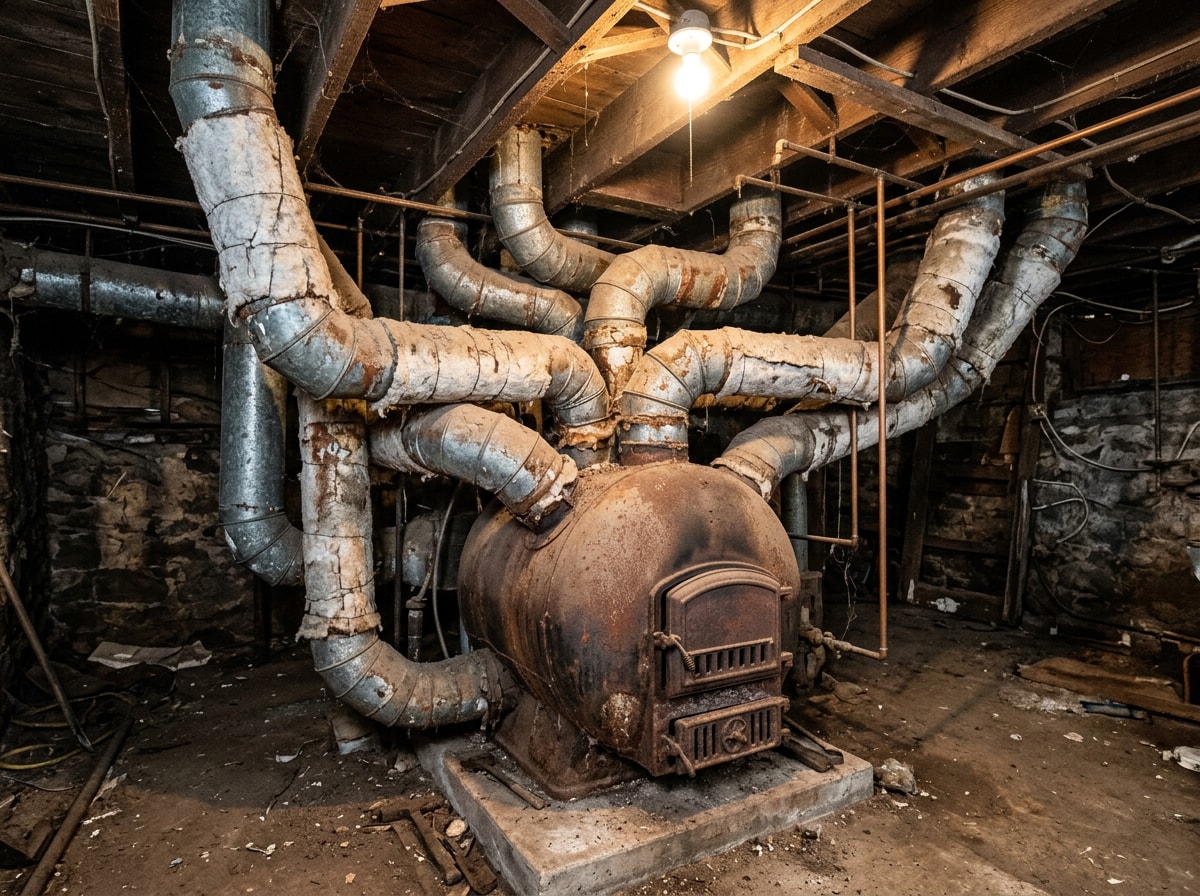
Furnaces installed before the 1980s very often contain asbestos insulation, which may appear as thick white wrapping or cardboard-like sheeting around the furnace body and ductwork. Asbestos fibers are dangerous mainly when disturbed, such as being cut, sanded, crumbled, or otherwise released into the air. An intact, undamaged wrap may pose little immediate risk simply sitting in place.
Never touch, sand, or try to remove old furnace insulation yourself. The EPA's guidance on protecting your family from asbestos exposure explains that encapsulation or enclosure should only be performed by someone trained to handle the material safely.
Carbon Monoxide Risk
After decades of heating and cooling cycles, the metal in a gravity furnace's combustion chamber or heat exchanger seams can crack. Those cracks let combustion byproducts, including carbon monoxide, leak into the warm air supply instead of venting safely up the chimney.
Carbon monoxide is colorless and odorless, which makes it nearly impossible to detect without equipment. The CDC recommends installing battery-operated or battery-backup CO detectors near every sleeping area and replacing them on the manufacturer's schedule or at least every five years. Pairing detectors with an annual professional inspection of the heat exchanger and chimney is the simplest way to catch a problem before it becomes dangerous.
Signs It's Time to Replace a Gravity Furnace
A gravity furnace typically needs replacing when:
- Repairs are frequent or repair bills keep climbing
- Rust, yellowing flame, or scorch marks show up on the firebox
- Rooms stay cold no matter how long the furnace runs
- Gas bills rise despite no change in usage
- Technicians struggle to source parts for the old unit
- Ductwork, insulation, or the heat exchanger show visible damage
If two or more of these sound familiar, don't gamble on another repair. Schedule a free inspection and get a straight answer on where your system stands.
Gravity Furnace Replacement Cost Factors
Replacing a gravity furnace costs more than simply swapping in a new unit. The sprawling "octopus" ductwork has to be physically removed, which alone can take a full day or more of labor given its size and weight.
If asbestos is present, which is common in pre-1980s installations, testing and abatement add a significant line item before any new equipment goes in. Abatement pricing depends on how much material needs removal and whether it's contained to the furnace or has spread into surrounding ductwork.
Most homes also need at least partial ductwork modification, since gravity duct systems aren't sized or routed the way modern forced-air systems require. Local labor rates, basement or crawlspace access, and whether gas or electrical lines need updating all factor into the final number. Our furnace replacement team can provide a line-item quote after an in-home evaluation.
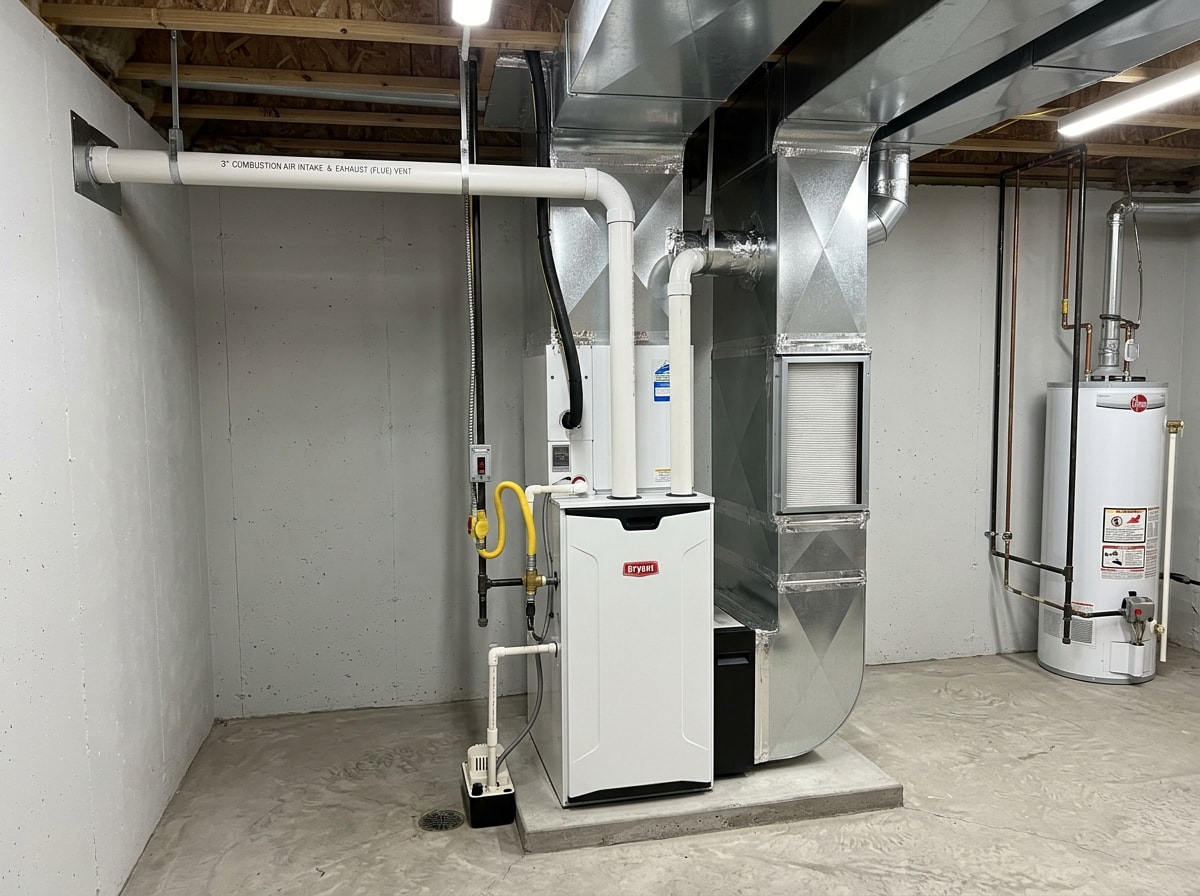
Types of Replacement Furnaces
Homeowners replacing a gravity furnace typically choose between four fuel types, each with different upfront and operating costs.
A natural gas furnace is the most common replacement in areas like Sandy Springs where gas service already runs to the home. It offers a good balance of installation cost and low operating expense. An electric furnace costs less upfront and skips the chimney and combustion safety concerns entirely, but monthly operating costs are usually higher in a climate with real winter heating demand. An oil furnace remains an option in homes without gas access, though it's become less competitive as efficient gas and electric options improve. A propane furnace suits homes without natural gas lines nearby, with efficiency similar to gas units but fuel costs that fluctuate more.
Most Sandy Springs homeowners with existing gas service end up choosing a high-efficiency furnace upgrade, since it keeps operating costs lowest over the unit's lifespan. If you're weighing a full system upgrade rather than a like-for-like swap, our Central Heating and Cooling in Woodstock, GA guide walks through how gas, electric, and heat pump options compare for Atlanta-area homes.
Cost Analysis: Repair, Replace, or Keep?
Deciding whether to repair, replace, or keep running an old gravity furnace comes down to comparing what you're spending now against what modern equipment would cost to run and install.
Operating Costs
A gravity furnace near 50% efficiency burns noticeably more fuel per heating season than a modern system. A standard 80% efficient forced-air furnace heating the same space uses meaningfully less fuel, and a high-efficiency unit at 95%+ AFUE uses less still. Over a 10-15 year ownership period, that efficiency gap can add up to thousands of dollars in avoidable heating costs. The Department of Energy's consumer guide to home heating and cooling breaks down how AFUE ratings translate into real-world fuel use.
Replacement Costs
A full gravity furnace replacement project typically includes several line items: new furnace equipment, installation labor, removal of the old octopus unit and ductwork, new ductwork sized for forced-air operation, and asbestos abatement if materials test positive. Asbestos abatement and extensive duct replacement push projects toward the higher end of the cost range.
DIY vs. Hiring a Pro
Removing and replacing a gravity furnace is not a reasonable weekend DIY project. Gas line disconnection, chimney modifications, and combustion safety checks all require licensing. Mishandling any of them creates real fire or carbon monoxide risk.
If asbestos testing comes back negative, homeowners may be able to assist with non-hazardous tasks alongside their contractor, like clearing the basement or removing old registers. Once asbestos is confirmed, every part of the demolition needs to go through a certified abatement crew before an HVAC technician can even access the equipment.
A licensed contractor also handles permitting, inspection, and warranty registration correctly the first time. Our furnace installation team coordinates abatement, removal, and new equipment setup as one project instead of three separate headaches.
FAQ
Can a Gravity Furnace Be Converted to Forced Air?
No. The gravity furnace itself can't be converted; it has to be fully replaced with a new forced-air unit. This usually means installing new, properly sized ductwork, since gravity duct systems aren't compatible with blower-driven airflow, and professionally removing any asbestos insulation on the old unit first.
Are Gravity Furnaces Safe?
Generally, yes. An intact gravity furnace, even one wrapped in asbestos insulation, can operate safely for years. The risk comes from disturbance: cracked heat exchangers releasing carbon monoxide, or asbestos fibers released during repairs, inspections, or renovation work. Undisturbed, properly maintained units pose far less immediate danger than most homeowners assume.
How do I know if my furnace has asbestos?
Look for thick, white or gray wrapping, cardboard-like sheeting, or a chalky coating on the furnace body and ductwork. Furnaces installed before 1980 carry a high chance of containing asbestos. Never scrape, cut, or handle suspect material yourself; a certified abatement contractor needs to test it first.
Are Gravity Furnaces Good or Efficient?
Not by modern standards. Gravity furnaces typically operate at 50-65% AFUE, meaning nearly half the fuel burned is wasted. Today's forced-air furnaces reach much higher efficiency, so a gravity furnace will almost always cost more to run each winter than a modern replacement, even though the equipment itself may still function.
How Long Do Gravity Furnaces Last?
The mechanical unit itself can often run 50 to 100 years or more, since the design has so few moving parts to wear out. That longevity doesn't offset the efficiency losses or safety concerns that come with age, so most HVAC professionals recommend replacement based on condition and safety rather than how long the furnace could theoretically keep running.
About the Author
This guide was written by the installation team at AK Service HVAC, led by Senior Technician Marcus Alvarado, a NATE-certified HVAC technician who has removed and replaced gravity furnaces in Sandy Springs basements for over a decade. Questions about a specific unit? Contact our team for a straight answer before you commit to a repair.